
From ancient knowledge to the Anglo-Australian Telescope
The Long Story of the Sky
For more than 65,000 years, the night sky has served as a living map, calendar, and law book for the First Peoples of this continent. Here in Gamilaraay country, that tradition remains vibrant today. The same dark sky that carries the stories of the Dark Emu and the Dark Hunter continues to arch over the Warrumbungle National Park — Australia’s first International Dark Sky Park — as well as the renowned Anglo-Australian Telescope (AAT) perched high on the mountain. This unique convergence of ancient knowledge and modern science shares one ridgeline.
This eight-week series traverses the realms of the ancient and the modern. It begins with the celestial figures that have guided generations, transitions through the classical era, and highlights the great navigators and observers, Australia’s early scientific endeavors, leading up to the contemporary astronomers who nurtured a national culture of the stars.
The series culminates with the exploration of the AAT and the invitation to visit the Dark Sky Hub — a special place where the rich human narrative of the sky can be experienced, honored, and utilized to inspire the next generation.
We start where the story has always begun — looking up.
The Eight-Week Journey
This series unfolds week by week:
Week 1 — First Nations Skies
Week 2 — The Classical World
Week 3 — Navigators of Sea and Sky
Week 4 — The Great Observers
Week 5 — Australia’s Early Chapter
Week 6 — Modern Australian Giants
Week 7 — The AAT and Siding Spring
Week 8 — The Continuum and the Invitation
Each week adds another layer to the same ridgeline — from the Dark Emu still visible in our skies to the glass and steel of the Anglo-Australian Telescope (AAT) that now stands beside it.
Return here as the story grows. The full journey is being written under the same dark sky that has always arched over the Warrumbungles.
Warrumbungle Dark Sky Park: From Ancient Knowledge to the Anglo-Australian Telescope
For more than 65,000 years the night sky has been a living map, calendar and law book for the First Peoples of this continent. Here in Gamilaraay country that tradition is still alive.
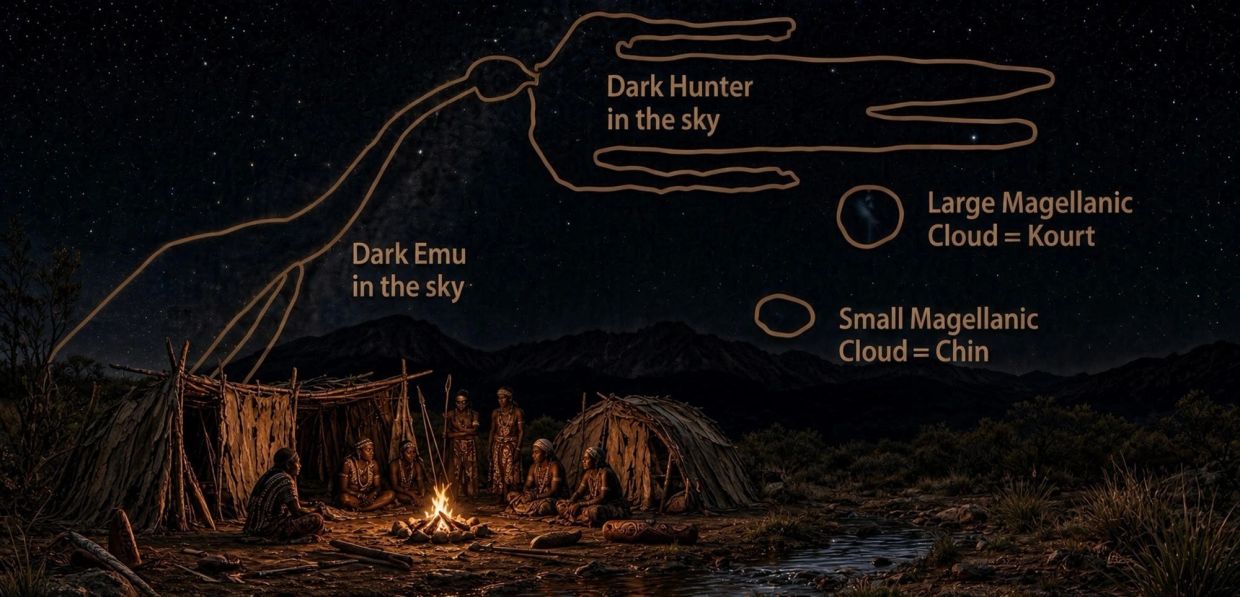
The Dark Emu rises in the dark dust lanes of the Milky Way. Beside it stands the Dark Hunter. At the beginning of the emu laying season the Hunter lies down — a clear signal to stop hunting so the next generation can continue. Nearby sit Kourt and Chin, the Magellanic Clouds.
These are practical knowledge systems that kept people in right relationship with Country. The same dark sky still arches over the Warrumbungle National Park — Australia’s first International Dark Sky Park — and over the Anglo-Australian Telescope high on the mountain. Ancient knowledge and modern science share one ridgeline.
We begin where the story has always begun — looking up.

Week 2 — The Classical World
While the dark sky over this country was already a map and a law book, other peoples around the Mediterranean were writing the sky down. In Babylon they kept night watches and recorded the paths of planets for centuries. In Egypt the rising of stars marked the year and the flood. In Greece the sky became a thing that could be measured. Hipparchus listed the stars. Later writers tried to hold the whole heavens in number and circle.
That work did not replace the knowledge already held here. It added another way of looking. The same act sits under both: stay out after dark, watch what returns, pass it on.
Those written charts later crossed oceans in the hands of navigators. They are one of the lines that, much later, helped put a telescope on a mountain. The ridgeline above Coonabarabran still holds both stories: the old sky that was never written in Greek, and the measured sky that became the Anglo-Australian Telescope.
Next week: the people who used the stars to cross water.
Week 3 — Navigators of Sea and Sky
The written charts of the classical world did not stay on stone and parchment. They went to sea.
In the Pacific, voyagers crossed open water for centuries by reading stars, swell, birds and cloud. A star compass was not a paper map. It was a living circle of rising and setting points, held in the body of the navigator and passed from teacher to student. Those canoes reached almost every island in the great ocean. Some of that knowledge later sat beside European charts when ships came south.
Arab and Persian sailors used the kamal and the astrolabe to hold latitude on the Indian Ocean. Chinese fleets read the same southern sky. Dutch and English captains followed the Southern Cross and the Magellanic Clouds down the long run toward this continent. James Cook sailed with Tupaia, a Ra'iatean navigator whose sky knowledge and island map made the Endeavour more than a European ship.
None of that emptied the sky already known here. It added another set of hands that used the same dark.
Those voyages are one of the reasons a telescope later stood on a mountain in New South Wales. Navigation made the southern sky a working tool, not only a story. The ridgeline above Coonabarabran still holds both: the old sky that guided Country, and the measured sky that guided hulls across water.
Next week: the observers who stayed still long enough to measure what the sailors had used.
Week 4 - The Great Observers
The sailors had used the sky. The next people stayed still long enough to measure it.
On a small Danish island, Tycho Brahe spent years marking the positions of stars and planets with large instruments and no telescope. His numbers were the most careful of their time. Johannes Kepler worked through those records and found that the planets move in ellipses, not perfect circles. Around 1609 and 1610, Galileo Galilei turned a small telescope upward and saw mountains on the Moon, moons circling Jupiter and the Milky Way breaking into countless stars.
Then the glass grew. Isaac Newton built a telescope that gathered light with a curved mirror instead of a lens. William Herschel and his sister Caroline took that idea further, grinding bigger mirrors and sweeping the northern sky night after night. William found Uranus. Caroline found comets of her own.
The southern sky had to wait for people to come south. In the 1750s Nicolas-Louis de Lacaille worked from the Cape of Good Hope and catalogued thousands of southern stars, naming new constellations along the way. In the 1830s John Herschel, William's son, took his father's kind of telescope to the Cape and surveyed the southern nebulae, star clusters and double stars, including the Magellanic Clouds.
None of that was the first careful watching of this sky. Gamilaraay people had already followed the Dark Emu across the seasons and read the sky as law and calendar for countless generations. The observers added mirrors, numbers and patience of another kind.
That thread runs straight on: careful eyes, then better instruments, then bigger mirrors. It leads, in time, to the Anglo-Australian Telescope on the ridgeline above Coonabarabran, still gathering light from the same southern sky.
Next week: Australia's early chapter, when the watching began from this side of the world.
---
Week 5 — Australia’s Early Chapter
The observers who measured the sky did so mostly from the other side of the world, or from the Cape.
On this side the sky had already been read for more than 65,000 years.
When the colony began, European eyes brought clocks, circles and written catalogues.
In 1821 Governor Sir Thomas Brisbane arrived with instruments and two assistants, Carl Rümker and James Dunlop.
They set up the Parramatta Observatory, the first permanent observatory in the colony.
They timed stars as they crossed the meridian. They recorded positions for thousands of southern stars.
The Magellanic Clouds, known here as Kourt and Chin, were measured again with brass and paper.
None of that emptied the sky already known on this ridgeline.
It added another set of careful eyes that would later help place a large telescope on the mountain above Coonabarabran.
Next week: the modern Australian giants who built a national culture of the stars.